

TParashat Tsav
from Likutei Torah
by Rabbi Shneur Zalman of Liadi
Translation and Commentary by Rabbi Gedalia Potash and William Schecter, MD
Wednesday May 4, 2022
This draft has been neither edited nor approved by Rabbi Potash
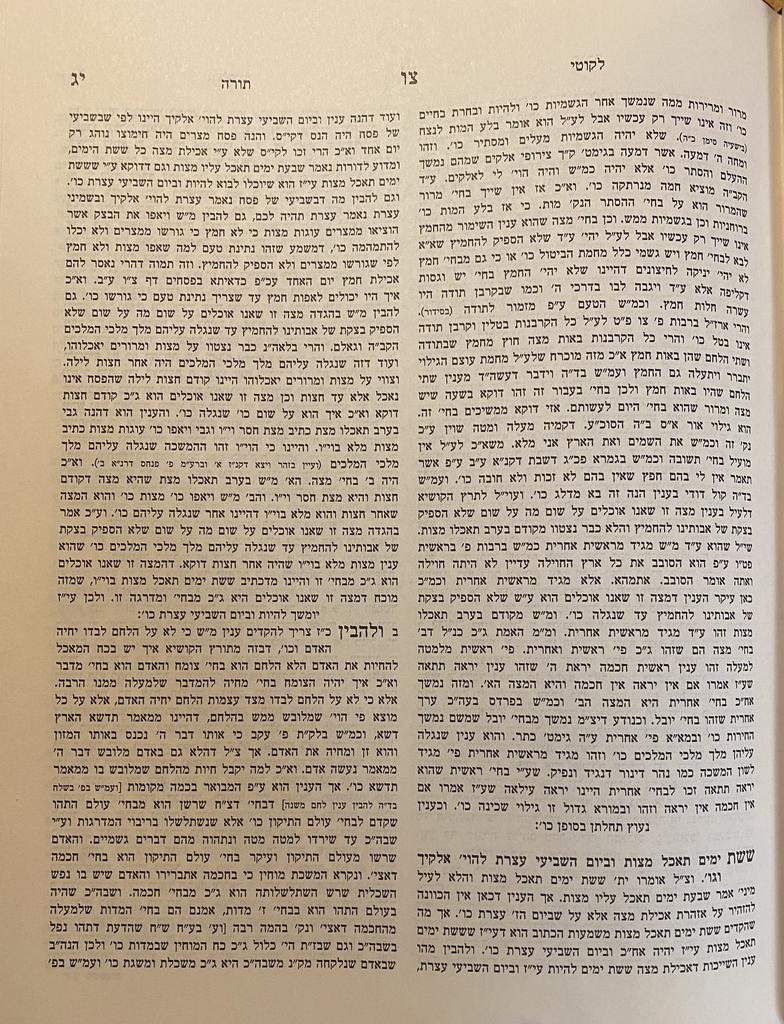
page יג, column 1, last paragraph
This Kabbalistic commentary on Parashat Tsav deals with the commandment to eat Matzot on Passover. The Elter Rebbe in his commentary demonstrates how eating the Passover Matzah leads to a nullification of the material and ascendancy of the soul spiritually achieving an intimate connection to G-d. Let us follow his analysis.
“Six days you shall eat Matzot and on the seventh day there will be an Atzeret for the L-rd Your G-d etc”. (Deuteronomy 16:8) We must understand that the L-rd saying “for six days you shall eat matzot and he did not say seven days you shall eat Matzot. But the point here is that there is no intention to caution against eating Matzah but rather the intention is to point out that the seventh day is an Atzeret.
Comment: What does the word Atzeret mean? In many English translations, it appears as “Assembly”. Others liken it to a Chag, a Holiday. And indeed, the seventh day of Passover is a Holiday like the first day (In the Diaspora, the first two days are Holidays as well as the last two days). But the root of the word Atzeret (עצרת) is עצר which means stop. In other words, after the excitement of Passover and the Chol Hamoed (the intermediate days) we are supposed to stop, relax and contemplate the meaning of Passover before it ends.
The significance of the passage which preceded the commandment to eat Matzot for six days of eating Matzot is that afterwards there is an Atzeret on the seventh day. What is the relationship between eating matzah for six days and the Atzeret on the seventh day? The seventh day is an Atzeret for the L-rd your G-d meaning that on the seventh day of Passover the miracle of the splitting of the Sea of Reeds occurred. In the Torah itself, we are instructed to eat Matzah only on the first day of Passover. After the Exodus on the first day until the splitting of the sea on the seventh day there originally was no requirement to eat Matzah. So, why in future generations are we commanded to eat Matzot for seven days and then on the seventh day have an Atzeret?
Furthermore, why does the Torah say that on Passover there will be an Atzeret on the seventh day for the L-rd your G-d and yet on Sukkot the Torah says that there will be an Atzeret for you on the eighth day? The Elter Rebbe then raises an additional question about another passage in the Torah: We must also understand the passage in the Hagadah which states “They baked the Matzot and it did not rise because they were exiled from Egypt and there was not enough time for the dough to rise.” This passage, he says, is strange because in the Talmud it says that the Children of Israel were forbidden to eat Hametz on the first day only (Pesachim 96: b). If so, how could they have baked chametz until it had the taste of bread because they were exiled and could not delay for the dough to rise? If so, how were they able to bake the Hametz until it gave taste because they were exiled?
Also, we must understand the passage in the Hagadah: “We eat this Matzah because our forefather’s dough did not leaven until G-d was revealed to them and they were redeemed”. Ein Hachi nami (it is certainly true) that they were already commanded to eat matzah and maror and that the L-rd was revealed to them after midnight, meaning the commandment to eat matzah and maror preceded the midnight of the Passover and yet we eat the Matzah both prior to and after midnight.
Comment: The Elter Rebbe is raising a series of questions and apparent contradictions in our texts. He now goes on to explain the apparent contradictions.
The commandments about eating Matzot and Maror refer to the time prior to the midnight of the Passover. The Matza is only eaten prior to midnight. And this Matzah which we eat is also prior to midnight. If so, why in the Hagadah does it say that we ate Matzah until G-d was revealed to the Children of Israel and they were redeemed? The issue, says the Elter Rebbe, is that in the passage stating “in the evening prior to midnight you shall eat Matzot”, the word Matzot is written without a vav.
The point is that in the passage which states “You shall eat Matzot in the evening, the word Matzot (מצת) is written without a Vav. And in the passage which states “they baked Matzot…”, the word Matzot (מצות) is written with a Vav. This means that the Vav is the drawing down of the revelation of G-d. If so, there were two attributes of Matzah. The first, represented by the passage “and in the evening you shall eat Matzot – refers to the Matzah prior to midnight which is the Matzah lacking the Vav. And the second “They baked Matzot….” Refers to the matzah after midnight which contains the Vav meaning after the revelation of G-d. Therefore, it is said in the Hagadah “Why do we eat this matzah? Because the dough of our forefathers did not leaven until G-d was revealed.” which is the point of the Matzot written with the Vav which was after midnight. This Matzah which we eat also had this attribute meaning that the passage “Six days you shall eat matzot”. The word matzot is also written with a Vav. This proves that the Matza that we eat also has this attribute (of revelation) And therefore, because of this, the seventh day (of Passover) is an Atzeret for the L-rd you G-d.
In order to understand this, it is necessary to discuss the passage “Man does not live by bread alone”. This passage explains the question “how does food have the power to vitalize man?” Does not bread have the attribute of vegetation and man the attribute of speech? If so, how does vegetation have the attribute of giving life to a human who is so far above vegetation in terms of spirituality? Rather because “not by bread alone” refers to the essence of the bread which gives life to man. All the utterances of G-d are enclothed within the bread. This means that the utterance “The land will be covered with vegetation”, as is written in Likutei Torah Parashat Ekev, indicates that the word of G-d enters the food and it is the word of G-d that gives life to man. But isn’t the word of G-d also enclothed within man for G-d said “We shall make man …”? If this is the case, why does man receive life from the bread which enclothes the utterance “the land will be covered with vegetation”? The explanation appears in several places. The root of the inanimate, the vegetation and the animal is the world of “Tohu” which preceded the creation of the world of “Tikkun”. The energy of Tohu flowed down through the myriad of spiritual levels by the breaking of the vessels until they reached the lowest level (our physical world) and the physical entities were created from them.
Comment: The breaking of the vessels refers to the 10 Sefirot which are unable to contain the powerful G-duly energy which is unorganized. The vessels shatter and 288 sparks fly down from the supernal world of Tohu until they reach our world. No one knows the exact definition of the word Tohu and in fact the entire process of creation is beyond human comprehension. Tohu usually is translated as a void or chaos. We can think of it as unorganized infinitely powerful energy.
On the other hand, the root of man is in the world of Tikkun the main attribute of which is Chochmah D’Atzilut (the Attribute of Wisdom in the world of Atzilut—the highest of the spiritual worlds, the one closest to G-d).
Comment: This means that the paradoxically, the spiritual level of the world of Tohu is higher than the world of Tikkun and therefore the spirituality and energy in the vegetation from the world of Tohu is greater than man’s intellect and can vitalize him.
It is called the intellectual energy because through intellect the world will be refined and man has within him the intellectual soul which is capable of refining the world. The root of Hishtalshalut (downward flow) also has the attribute of wisdom. The breaking of the vessels occurred in the world of Tohu which has the attribute of the 7 attributes.
Comment: This refers to the 7 emotional attributes (chesed, tifferet, gvurah, netzach, hod, yesod, malchut). We have not encountered a detailed treatment of these 7 emotional attributes so far in our studies. These 7 emotional attributes are on a lower spiritual level than the three intellectual attributes (Chochmah, Bina and Da’at) which we have discussed extensively.
Indeed, the 7 emotional attributes are the attributes which are above the Chochma of Atzilut and are called the great beast ….
Because the attributes did not have within them the attribute of complete inclusion, they broke and fell below man and therefore it is necessary to be refined by man because the refinement occurs through wisdom as discussed above. But after refinement, they vitalize man from the side of their root which is above man (that is in the world of Tohu)
This is what is meant by the expression man lives by all the utterances of G-d’s mouth. The meaning of the utterances of G-d’s mouth is that they are the source and root from which G-d’s Energy is drawn to be revealed the utterances of G-d’s mouth. Bread, however, is taken from an even higher attribute as discussed above. This is the reason that the utterance “Let us make man in our image” (Genesis 1:26) is the last of the 10 utterances and the utterances “Let the earth sprout vegetation “(Genesis 1:11) and “The earth brought forth vegetation” Genesis 1:12) etc. all precede the utterance “Let Us make man in our image”. The reason for this was discussed above: the root of vegetation is in the world of Tohu which preceded the world of Tikkun which is the root of man.
Therefore, Rav Nahman said “the reason I didn’t tell you in the beginning of the night (earlier) is that I did not eat the meat of the bull”. (Baba Kama 72:a)
Comment: What is this quotation doing here? The answer is found in the Talmud portion from which it is taken. Rava and Rav Nahman are discussing a case of a son who steals his father’s bull and slaughters it. The details are not important for our purposes. If you are interested, the discussion starts in Baba Kama 71: b and the quotation is from the beginning of 72: a. The point is that Rav Nahman changed his position on a point they were discussing the night before. The reason he put forth for his change of position is that he had not eaten and therefore was unable to concentrate. The Elter Rebbe then continues.
This (the quotation) teaches us that food adds the power of the wisdom and the intellect in addition to vitality to man. The Rabbis said that a baby does not know how to say father until he has tasted grain (that is he has been weaned from the breast) due to the reason cited above. The root of the food is above in the world of Tohu which is above the Chochma (wisdom) in the world of Tikkun. Therefore, food has the power and the ability to strengthen and add to both the strength and wisdom of man.
As it is written here, it is understood that the Service of G-d is the issue the refinement of the 288 sparks of Tohu which are invested in material entities what are refined (by man) and ascend on high to the world of Tikkun, the root of the G-dly Soul in man. Meaning that through service to G-d by recitation of the Sh’ma and prayer, the attributes of power and vitality which are added to it through eating for the purpose of Heaven are included in the “One” and “You shall love” and increases the power of contemplation and excitement of the love of G-d to be the contemplation and the knowledge and the assertive love and fear and the connection greater than the power of the G-duly soul itself for the reason cited above to be invested in them with the attribute of the 288 sparks of Tohu which are above the attribute of Tikkun. Therefore, they also have the ability to add supernality to the attribute of Chochma and the seven emotional attributes that are in the G-duly Soul by recitation of the Sh’ma, and prayer and engagement in Torah study and commandments.
Comment: The passage above explains that according to Kabbalah the purpose of man is refinement of the 288 sparks which fell to earth after the shattering of the vessels containing the disordered G-duly Energy. This refinement occurs through contemplation of the Sh’ma, Tfilah (prayer), Torah study and Mitzvot. The spirituality of food, as represented by Matzah, comes from the Tohu which is higher spiritually than the world of Tikkun (which is the source of man’s G-dly Soul. Therefore, both spiritually and materially, food adds to the power of man to fulfill the Mitzvot and refine the 288 sparks and by extension the world making it a dwelling place for G-d.
When the Elter Rebbe talks about “the One” and “And you shall love…”, he is referring to the first two paragraphs of the Sh’ma—the powerful declaration of monotheism and the duty of man to love and serve G-d.
It is understood also regarding the issue of the Mitzva of eating Matzot on Passover as explained in the Zohar (Parashat Veyatsah, 157: b) the following: Just as a baby does not know or contemplate anything until he has tasted the bread as explained above, similarly when the Children of Israel left Egypt, they did not know how to contemplate the Greatness of G-d until they ate Matzah, which has the attribute of the bread which is brought forth from the supernal earth. For man will be vitalized by the word of G-d brought down by this bread, and the G-duly Soul will truly know the One who spoke following which the world came into existence. Similarly, the vitality was brought down to the intellectual soul from the material bread referred to above. Therefore, eating Matzah during Passover draws down to our world the knowledge to truly know and connect with the G-duly Soul.
Comment: The Elter Rebbe uses two words in the last sentence to express the concept of to know: Leyedah (לידע) and Lehakir (להכיר). Leyedah implies knowing something intellectually. Lehakir implies a more personal and intimate connection. Therefore, I have translated Lehakir using the word connect.
The leavened bread has the attribute of pridefulness and haughtiness which swells, ascends and elevates itself. If this is so, Matzah lacks any condescending quality. Similarly, in the service of G-d, leavening has the attribute of the pride and vulgarity of the Klipah.
Comment: Recall that the Elter Rebbe uses the word Klipah to refer to the Klipat Nogah, the fourth material layer surrounding the G-duly Soul which contains elements of the Yetzer HaRa (the physical material inclinations) as well as G-duly elements.
Matzah has the attribute of lowering and bending with the attribute of nullification of your will…
Comment: Matzah, says the Elter Rebbe, represents humility. By eating Matzah, man his nullifying his material desires and impulses in favor of service to G-d.
The Children of Israel were bound tightly below (in the material world) by the Exile in Egypt. Their intellect and emotional attributes had the attributes of material borders and limitations causing them to come into physical existence and be separate. The King of Kings was revealed to the Children of Israel by the Exodus from with the attribute of the Eternal Light which is above the order of Hishtalshalut and through the attribute of nullification was drawn down to them. The revelation of the Shechinah caused great fear and through the nullification and the supernal fear (vision) they left all the limitations and boundaries of Egypt.
Comment: Rabbi Potash pointed out the root of the words for “fear” (יראה) and “see” (ראה) is the same: ראה. So that the revelation of G-d that occurred during the Exodus (the splitting of the Reed Sea, the Giving of the Torah at Mount Sinai) caused the Children of Israel to be released from their material bonds and boundaries, to see (metaphorically) G-d and to experience awe and fear in His Presence.
The physical Exodus from Egypt occurred after midnight. Indeed, the Children of Israel were first commanded to eat matzah prior to midnight as it is written “in the evening you shall eat matzah” which has the attribute of nullification of will, submission and baseness, flowing down with the attribute of lower Yirah (Fear) which is the preparation and the vessels for the attribute of revelation and supernal yirah (Fear-Awe) which flowed down and was revealed to them after midnight.
Comment: The Galut (Exile) in Egypt was not only a physical but also an emotional and psychological exile. The Exodus was one level of revelation. The Children of Israel were at least aware of greater possibilities (in terms of spiritual elevation) but they still had to do the work for the revelation at Mt. Sinai.
They were still in the Egypt mindset initially. During the Exodus, they had a revelation from a world higher than Hishtalshalut (the process of flowing down of the G-duly Energy from the supernal heights to our world). When you see such greatness which is not yet a part of you, says Rabbi Potash, you experience a sense of Bitul (nullification). You nullify you own material desires in favor of humility before G-d.
Matzah is called Michlah Dmhimnuta (מיכלה דמהימנותא=Food of Faith) in the Zohar. Faith also has the attribute of nullification because faith nullifies one’s intellect and doesn’t require a reason, only belief in the truth of pure faith. This attribute of faith flows down to the Soul by way of the Mitzvah of eating Matzah. How so? We previously discussed the analogy of bread giving life to man and the analogy of the baby who is able to call “Aba” (father) after knowledge flows into him and is renewed within him the taste of the bread. The baby’s knowledge does not have the attribute of understanding, reason or complete knowledge for the baby does not know how this person came to be his his father, and why he must love him. Nevertheless, he calls his father and this cry is his connection with his intimate knowledge (Hakarah) of his father alone which is minute, below reason and knowledge (Da’at). What does this mean? Because this knowledge is renewed in the baby by the taste of the bread, its root is from the root of the bread in the world of Tohu which has a higher spiritual level than knowledge and higher than wisdom, as discussed above. Therefore, it flows down below the conceptual mind. If so, the connection is very strong. The situation is similar to the issue of eating Matzah for Matzah is called the Bread of Faith in the Zohar. Faith is the intimate knowledge, the conceptual knowledge and the connection to G-d and all Israel believes He alone is the One who preceded the creation of the world as it is written: “I am G-d, I have not changed” (Malachi 3:6). This flowing down has the attribute of supernal knowledge because G-d is above Wisdom, etc. Therefore, the G-duly Energy is drawn down and enclothed in Faith.
That is the reason that Matzah is the bread of faith for the root of the bread in the world of Tohu discussed above enables the baby to call father because of the bread. But this is with education of this material world which is drawn from the material bread drawn from the physical earth. In contrast the “bread” of the Passover Matzah enclothes the power of the supernal earth from which the bread is derived. This bread (Matzah) draws down this attribute of true Divinity giving the knowledge to call the Father in Heaven etc. with a powerful connection until it exists in the Soul but it does not achieve true reason and understanding. This is the attribute of nullification. From this flowing from the Passover Matzah, we also achieve the nullification of human will and the attribute of baseness and “may my soul be like dust for all” (Brachot 17: a:4) which is the power of the earth from which the bread came forth.
Comment: Let’s try to unpack the ideas expressed in the paragraphs above. First let’s start with a play on Hebrew words employed by the Elter Rebbe. The word טעם (Ta’am) has two meanings: taste and reason. So, when the Elter Rebbe says that the taste of the bread gives the baby the knowledge to say “father”, he is alluding to the fact that the bread gives sustenance both to the body and the intellect. But even though in the process of development the child comes to an understanding, the child really doesn’t understand the process. So how does the baby achieve this deep connection. Rabbi Potash explains that according to Kabbalah, if you have a suspension of intellect, you can have a deeper connection to G-d. Chochma diminishes the connection
You can have a relationship above chochma—like the emotions of Tohu—or you can have emotions that are lower, lesser, than chochma The common denominator is that there is no chochma to diminish the relationship. Ultimately there is a level of connection higher—a supernal intimate connection to G-d which is higher than Wisdom and reason. Similarly, by eating Matzah, the Jew develops a suprarational intimate connection with G-d. Spinoza, of course, rejected this concept of supernal knowledge, i.e., suprarational knowledge and connection but it is a central element of Kabbalistic and Chasidic thought.
Says Rabbi Potash: physical grain (bread) develops the physical brain. Spiritual grain-matzah-develops our intimate emotional connection to G-d. Therefore, eating Matzah helps us nullify our physicality to reach a higher spiritual plane and an intimate connection to G-d.
This translation and commentary end in Likutei Torah, Parashat Tsav, page 26, column 2 at the end of the first paragraph. The text below continues the translation and commentary from where we left off
Parashat Tsav from Likutei Torah
By Rabbi Shneur Zalman of Liadi
Translation and Commentary by Rabbi Gedalia Potash and William Schecter, MD
May 11, 2022
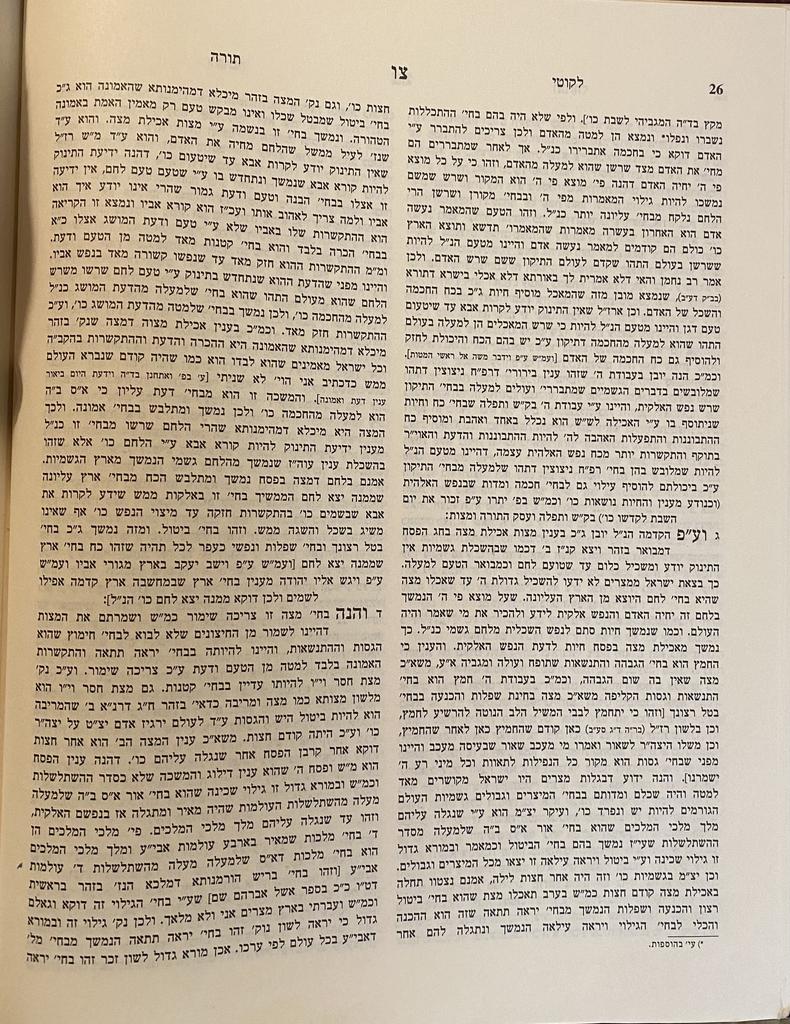
page 26 column 2 starting with the second paragraph
This Matzah (that is the Matzah eaten before midnight) requires conservation (protection) as it is written” and you shall keep (protect) the Matzot (Exodus 12:17) meaning you should protect the Matzot from external influences which might lead to leavening which is analogous to vulgarity and haughtiness. This means that this Matzah has the attribute of lower fear and connection of faith alone below reason and knowledge and therefore it requires protection. Therefore, the word Matzot (מצת) is written without a Vav, referring to the Matzot eaten prior to midnight which requires protection. This Matzot written without a Vav is therefore “undeveloped” or” immature”. In addition, the Matzah lacking a Vav is related to the ͏מ͏צותא (Metsutah—an Aramaic word meaning argumentative) similar to Matzah and disputation. It is written in the Zohar that conflict is necessary to achieve nullification of material vulgarity. This is analogous to the continuous conflict in man between the Yetzer Hate (the good inclination) and the Yetzer Hara (the evil inclination) and therefore the Matzah lacking a Vav was eaten prior to midnight.
Comment: G-d revealed Himself to the Children of Israel at midnight on the 14th day of Nissan prior to the Exodus from Egypt. The Matzah eaten prior to the revelation spiritually has the attribute of fear and faith below Chochmah, Binah and Da’at—that is below reason. Therefore, it is undeveloped or unrefined and requires protection from external influences and the Yetzer HaRa (the evil inclination) present in all of us.
Rabbi Potash commented: When we speak about the positivity of Emunah (Faith), we are talking about a suspension of intellect. The danger is that we are not using the intellect to filter out what is right or wrong. Therefore, we have to guard that faith and protect it against haughtiness and vulgarity.
The second type of Matzah (מצות), written with a vav, is eaten after midnight, after the Passover Sacrifice and the revelation of G-d.
Comment: The Passover, that is the passing over the houses of the Children of Israel by G-d, Rabbi Potash commented, is in fact the revelation of G-d to the Jewish People.
Now, what is the meaning of this discussion of Matzot with or without a Vav? We have to go back to Mishnaic times to discuss a second-generation Tana (one of the Rabbis discussed in the Mishnah) named נחוניא בן הקנה (Nehunyah Ben Hakanah). He spent most of his time searching for the secret hidden meaning of the Torah going so far as to posit that each letter has a spiritual meaning. The vav (ו) is a long straight letter and is thought to represent the drawing down of Divine Energy. So, writing Matzot (מצות) with a ו indicates that the Matzot has a higher level of spirituality than the Matzot (מצת) without the vav.
The Passover as it is written “And G-d passed over…” (Exodus 22:23) is a skipping and a drawing down of G-dly Energy outside the orderly Hishtalshalut (flowing down from one spiritual level to the next) and as it is written “And with great fear” (Deuteronomy 26:8) - this is revelation of the Shechinah” which is the attribute of the Divine Infinite Light which is far above the Hishtalshalut of the worlds.
Comment: The text in Deuteronomy cited above reads “G-d freed us from Egypt by a mighty hand, by an outstretched arm and great fear, and by signs and portents”. The Biblical text uses the word Moreh (מורא) for fear instead of Yirah (יראה) which the Elter Rebbe has been using up until now. Both words mean “fear” and “see” and both have the shoresh (3 consent root) ראה. However, the word Yirah is feminine and the word Morah is masculine. The Elter Rebbe will soon comment on the significance (Kabbalistically) of the gender difference.
This Divine Eternal Light would illuminate and be revealed in their G-dly Souls until the King of the King of Kings was revealed to them. The meaning of the King of Kings is the four attributes of Malchut (Kingdom) that illuminates the 4 worlds of Atzilut, Briut, Yetzirah and Asiyah. The expression the King of the King of Kings refers to the Malchut of the Infinite which is far above Malchut of the Hishtalshalut of the four worlds…. For through this revelation they (the Children of Israel) were redeemed as it is written “And I passed in the Land of Egypt. I and not an angel” (Passover Haggadah)
Comment: The word Malchut needs some explanation. The definition of the word Malchut is Kingdom. It refers to the tenth Sefira in the Kabbalistic tree and the lowest of the ten Sefirot. As opposed to the other nine Sefirot which emanate directly from G-d, Kabbalah teaches that Malchut emanates from G-d’s creation when that creation reveals the qualities of G-d’s Glory. All ten Sefirot are present in the worlds of Atzilut, Briah, Yetzirah and Asiyah (our world) and therefore the Sefirah of Malchut is present in each of these worlds with levels of spirituality appropriate to the level of the particular world.
And therefore, this revelation is called and with great fear (במורא גדול) because the word יראה (fear-Yirah) is a feminine word and this is the attribute of lower fear which is brought down to each of the four worlds each according to its value.
Comment: The Elter Rebbe is saying that there were two types of fear experienced during the Exodus. The lower level of fear-Yirah-a feminine word below the intellectual attributes, occurred prior to the revelation of G-d during the midnight Passover. The supernal fear – Morah-a masculine word-occurred after the Divine Revelation during the Passover itself.
Great Fear (מורא גדול) is a masculine word and this has the attribute of supernal fear which is a masculine attribute brought down by revelation of the attribute of the King of the King of Kings referred to above. The second type of Matzah eaten after midnight has the attribute of nullification discussed above. The Matzah eaten prior to midnight has the attribute of lower fear and faith as was enclothed with the attribute lower than knowledge and understanding referred to above.
The Elter Rebbe will now go on to quote Scripture to illustrate that Israel was in an undeveloped, unrefined state prior to the Divine Passover Revelation.
- I fell in love with Israel
When he was still a child;
And I have called [him] My son
Ever since Egypt. (Hosea 11:1)
- Go proclaim to Jerusalem: Thus said the LORD:
I accounted to your favor
The devotion of your youth,
Your love as a bride—
How you followed Me in the wilderness,
In a land not sown. (Jeremiah 2:2)
- And the Call of the baby “Father”
But the matzah eaten after midnight has the attribute of true nullification and supernal fear that is draw down with the revelation of what is above knowledge and understanding that illuminates the Soul. Meaning the revelation of the Divine Eternal Light which is above the Hishtalshalut that illuminates them far above the awakening from above, this is great fear—the revelation of the Shechinah.
Comment: Kabbalah posits a supernal knowledge far above the world of Atzliut and the beginning of the process of Hishtalshalut-the flowing down of Divine Energy through the various worlds to our netherworld—Asiyah. This supernal knowledge is really a deep intimate connection far above intellect. This concept led to the intellectual rebellion of Spinoza in the 17th century. He posited that the Laws of Nature could be discovered through reason alone without a supernal knowledge beyond reason. This blasphemous position led to a Cherem-an excommunication-from the Jewish Community of Amsterdam.
Therefore, this matzah requires no protection from leavening for it (leavening) has the attribute of existence and vulgarity. The external influences are unable to grasp and suck (that is influence with lewdness and vulgarity--because the supernal fear is the light of the Father which pushes away the external influences. Only the attribute of the lower fear requires protection etc.)
End page יד Column 1 line 13 beginning with the word שימור.
Likutei Torah Parashat Tsav
By Rabbi Shneur Zalman of Liadi
Translation and Commentary by Rabbi Gedalia Potash and William Schecter, MD
This translation has neither been edited nor approved by Rabbi Potash
June 1, 2020
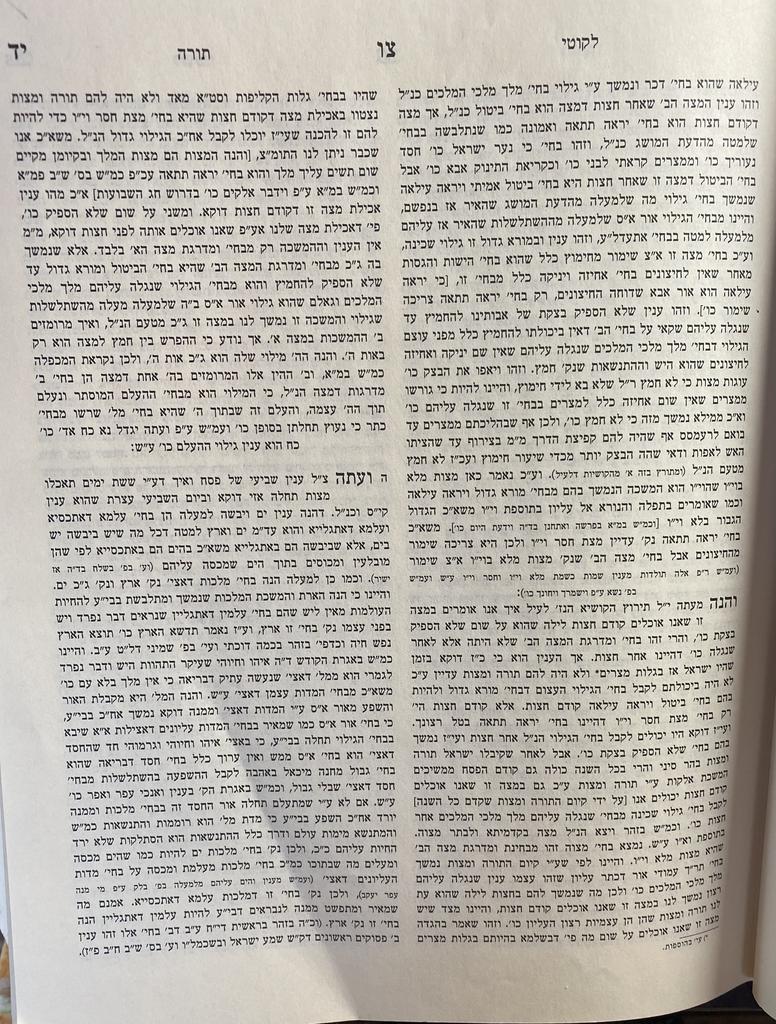
start page יד column 2 paragraph 2 beginning with the word ועתה
And now we must understand the 7th day of Pesach and how through eating Matzot first during the preceding 6 days we merited an Atzeret (a Holiday) on the 7th day which was the day when the Reed Sea was split.
Comment: The first day of Pesach is a Holiday (the first two days in the Diaspora) and the 7th day is an Atzeret. Rabbi Potash commented that in order for one to merit the Atzeret on the 7th day, it was necessary to eat Matzah for the preceding 6 days to prepare oneself spiritually for the 7th day.
Now we must consider the issue of supernal sea (ים) and dry land (יבשה) which have the attributes of concealment (sea) and revelation (dry land). In the lower realms (that is, the worlds below the world of Atzilut), there is the sea and the earth (ארץ). Everything present on dry land is present in the sea except everything is revealed on the dry land whereas everything is swallowed up and concealed within the sea.
In the supernal realm (the world of Atzilut) the attributes of Malchut in Atzilut are called Earth (ארץ) and Sea (ים).
Comment: We must pause here to allow Rabbi Potash to explain what is going on if we are to understand the Elter Rebbe’s argument. We have studied at length before about the 10 Sefirot which are the vessels containing Divine Energy. These Sefirot correspond to the 10 spiritual attributes which are located in each of the four main worlds in the Kabbalistic Cosmology: Atzilut, Briah, Yetzirah and Asiyah. The world of Asiyah (action in the lowest world spiritually, the one which we inhabit). The four worlds are in decreasing order of spirituality, the highest being Atzilut. The word Atzilut means nearness meaning nearness to the Divine Eternal Light.
Each of the worlds contains the 10 attributes also in decreasing order of spirituality. The highest are the three intellectual attributes (Chochmah-wisdom, Binah, Understanding, and Da’at-Knowledge). Below them are the 7 emotional attributes: Gvurah-Discipline, Chesed-Loving Kindness, Tiferet-beauty, Netzach-Victory, Hod-Splendor, Yesod-Foundation and Malcut-Kingdom.
The important point is that in the Malchut of the World of Atzilut, a paradigm shift occurs. In all the attributes in the World of Atzilut which are spiritually above Malchut, there was a feeling of oneness with G-d. The Elter Rebbe uses the word Dry Land (יבשה) to describe the complete revelation of G-d in the 9 attributes of Atzilut above Malchut. There has been a withdrawal of the sea to reveal everything. However, in the Malchut of Atzilut for the first time, the Elter Rebbe uses the word Earth (ארץ) to describe the revelation which is present in Malchut of Atzilut. This is in fact a reduced revelation.
How can we explain this in terms to which we can relate? Consider the powerful energy emanating from an electric power station. In order to use it safely in our homes, the power must be reduced. This is accomplished with a reduction transformer. By way of analogy, we can consider the Malchut of Atzilut to be a reduction transformer. The unrefined Eternal Energy enters Malchut (symbolized by the Dry Land—יבשה) and the reduced energy exits Malchut as it descends through the process of Hishtalshalut—the flowing down of the Divine Energy from one world to the next). This reduction in energy which occurs in the Malchut of Atzilut is called Tsimtsum (contraction-צמצום) and it occurs first in the Malchut of Atzilut).
So, if we continue with the analogy of the reduction transformer, Dry Land (unrefined revealed energy) comes into Malchut and Earth (refined reduced energy) goes out of the Malchut of Atzilut and descends to the world of Briah.
Similarly, the energy keeps getting reduced and refined in the Malchut of Briah as the process of Tsimtsum (contraction) continues until it flows down to the World of Yetzirah and so on.
This means that the emanation of Light from the Malchut (of Atzilut) flows down and is enclothed in the worlds of Briah, Yetzirah and Asiyah to animate the worlds from nil to existence and these worlds appear to have the attribute of revelation in that they appear to be entities in and of themselves. This is in fact the attribute of Land (ארץ) (because G-d is concealed). Two passages in the Torah relate to this: “Let the earth yield grass, herbs yielding seed, and fruit trees bearing fruit after their kind, with its seed in it, on the earth” (Genesis 1:11) and “"Let the earth produce living creatures after their kind, livestock, creeping things, and beasts of the earth after their kind"; and it was so.” (Genesis 1:24)
As it is written in the Letter of Holiness (the fourth part of the Tanya): in the passage beginning with the words “He and His Life are One”, the point of creation of separate entities comes from the Malchut of Atzilut that is made prior to Briah because “There is no King without a People” and if this is so, from the attribute of the qualities see there (in the Letter of Holiness).
Comment: What is the Elter Rebbe talking about? “There are no King without a People” (אין מלך בלא עם) is a basic Chassidic principle. The idea is that G-d needs His People in order to have a relationship with them. The idea of the creation of primordial man, referred to in the Kabbalah as Adam Hakadmon (אדם הקדמון) occurs in G-d’s thought in the world of Atzilut in which the vegetation and animal life have already been created. However, the actual creation of man, that is the implementation of the Divine Thought in Atzilut does not occur until the world of Briah, after the Eternal Light is reduced in the Malchut of Atzilut (Tsimtsum) and then passes down to the world of Briah. According to Kabbalah, had man actually been created in Atzilut, where the power of the Infinite Light is completely revealed, man would have been nullified by the power of the energy. It is through Malchut that concealment of the energy first begins allowing for the creation of man in Briah.
The Malchut receives the Light and the abundance from the Eternal Light through the Attributes of Atzilut (the nine attributes above Malchut) and this Light (now partially concealed) flows down to the worlds of Briah, Yetzirah and Asiyah. Why? Because the Eternal Light that illuminates the Supernal Attributes of Atzilut cannot be revealed in the Lower Worlds because in Atzilut He and His Attributes are One (completely revealed) and the Attribute of Chesed in Atzilut is infinite and cannot be compared in any way to the Chesed of Briah which has the limitation of the Camp of Michael in love to receive the abundant flow in Hishtalshalut from the Chesed in Atzilut, without borders or restrictions, as it is written in the Igrat Hakodesh (The Letter of Holiness—part of the Tanya) regarding the issue of “ And I who am dust and ashes” (Genesis 18:27) The Elter Rebbe then refers us to the Letter of Holiness for more information.
Comment: The Elter Rebbe is referring to the Kabbalistic concept of the Camps of Michael on the right and the Camps of Gabriel on the left. The Camps referred to the group of angels associated with Michael and a separate group associated with Gabriel. The Camp of Michael on the right is associated with the attribute of Chesed (Loving Kindness) as opposed to the Camp of Gabriel associated with the Attribute of Gvurah (Discipline). The point the Elter is making is that Chesed in Atzilut is infinite whereas Chesed in the lower world of Briah has already undergone Tsimtsum (contraction) and therefore has boundaries and limitations. In other words, the Chesed of Briah is unable to receive the infinite Chesed of Atzilut because it is unable to contain the limitless Chesed after having undergone Tsimtsum.
The Light of this Chesed in Malchut is first concealed and then descends to the worlds of Briah, Yetzirah and Asiyah. The Attribute of Malchut is the revelation and raising as it is written G-d “is elevated above the seas of the world”
Comment: This passage appears in the first prayer {Yotzer Or} prior to the recitation of the Sh’ma.
In general, the “raising up” refers to the disappearance (concealment), for the vitality descended upon them in a limited way and therefore the “sea” is the Attribute of Malchut (since the concealment of the Infinite Light begins in Malchut) just like the sea covers and conceals its contents. Similarly, Malchut conceals and covers the Supernal Attributes of Atzilut and therefore this Attribute of Malchut is called the World of Concealment (עלמא דאתכסייא ). Indeed, that which illuminates and disseminates from Malchut to the creations of Briah, Yetzirah and Asiyah to be the Worlds of Revelations, is called Earth (ארץ)….
Comment: Recall that Earth is a far reduced revelation compared to the complete revelation enjoyed in the upper nine Attributes of the World of Atzilut. This complete revelation is called “Dry Land” in the Kabbalah. So, the emanation from Malchut has already undergone Tsimtsum (contraction). Since in each of the worlds, there is Malchut, the reduced Light in Briah is further reduced when it descends through the Malchut of Briah to the lower world of Yetzirah. Likewise, the Light of Yetzirah is further reduced in the Malchut of Yetzirah prior to its descent to Asiyah.
In this way the Light and Abundance flows downward in the orderly process of Histalshalut from Atzilut to Briah, Yetzirah and Asiyah with the Attribute of Filling (the worlds) that then belong to the Attribute of Sea and Dry Land in the World of Concealment and the World of Revelation. Thus, it is the level of the Histalshalot (the flowing down). It is impossible for the Infinite Light and Abundance in Atzilut to be revealed in the Worlds of Briah, Yetzirah and Asiyah because the creations in these worlds have the attribute of boundaries and limitations. Therefore, the initial concealment in the World of Concealment permits the radiance and the descending flow which alone is the source of the abundance in Briah Yetzirah and Asiyah with the limited Attribute of Revelation.
Indeed, on the Seventh night of Pesach the great radiance from above would be illuminated and revealed in the order of Hishtalshalut from the Infinite One Blessed be He Who encircles the world (HaSovaiv Kol Haolamim) and equalizes all the worlds (because compared to Him they are all as nothing). So Atzilut and Asiyah are truly equal before Him as are the darkness and the light, in the order of Hishtalshalut of the Worlds of Concealment and Revelation—all are truly equal (and insignificant) compared to Him
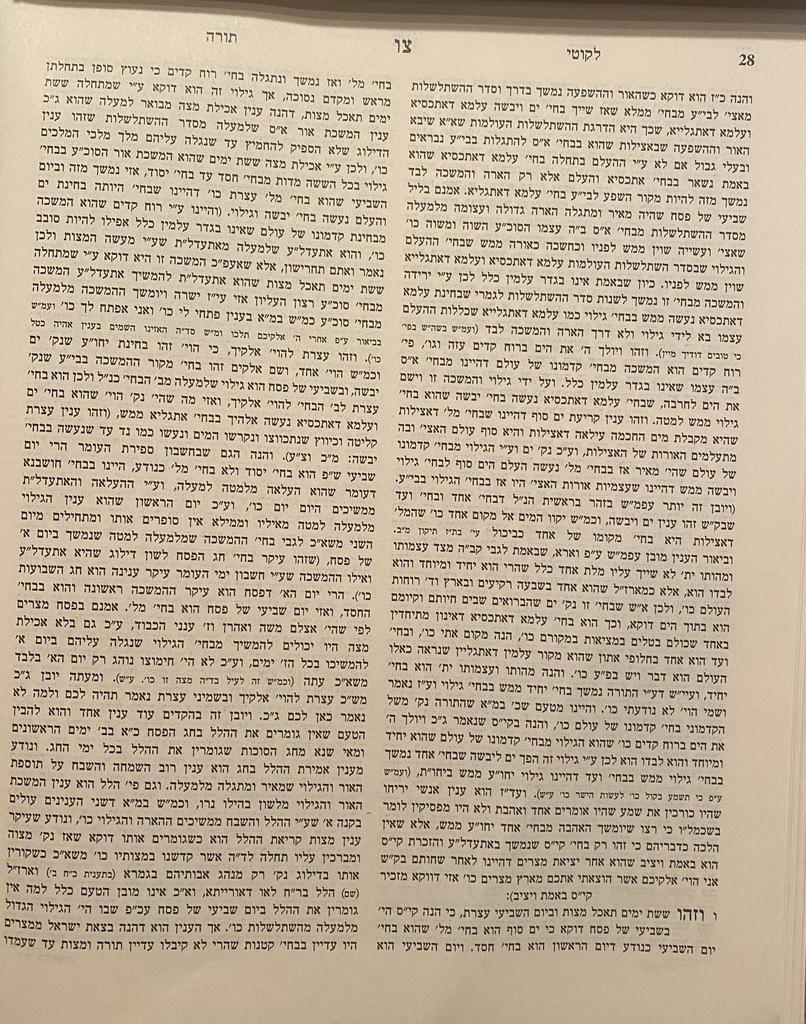
The translation ends on
page 28 column 1 line 11 beginning with the word גילוי.